
This month, five Tauranga-Western Bay community centres are running an awareness and fundraising campaign to future-proof their existence. It is shining a light on centres at Merivale, Welcome Bay, Gate Pā, Katikati and Te Puke. This week, Merle Cave visits the Welcome Bay Community Centre.
Tucked behind Welcome Bay Hall is a safe place catering to those in need of nearly anything.
Mid-morning on Wednesday, the Welcome Bay Community Centre is full of tables stacked with clothing of all sizes. Folk work their way through them as the coffee machine whirrs, driven by whānau connector Tanea Reihana, known as “Barnee”, and the kitchen servery offers orange-flavoured cupcakes.
All ages from toddlers to parents to kaumātua and people of different ethnicities are accessing things they need without fear of judgment. “It’s a safe space for people to come and feel connected,” Welcome Bay Community Centre manager Kim Ruddell said. She’s been in the job since April.
“We’re here to support people going through times. We want it to be a home away from home, where people can come have a coffee, relax and know that they’re not going to be judged or anything like that,” she said.
“One of our values is for every community member to know that they are taonga, a special gift.”
As one of the city’s smaller community centres, its offerings are huge. A usual week looks like this.
On Mondays, there is Tiny Tunes for parents and children, table tennis and a volunteer gives her warm baking to guests. A Rangatahi Club runs from 4pm-6pm for youth, aimed at those aged 14-plus. “We don’t turn anyone away here,” Ruddell said.
Tuesday is kai distribution day. “We’ve partnered with Good Neighbour [to give out free food]. We also get kai donations from local churches, schools and community members,” she said.
Every second Tuesday, a hairdresser volunteers to cut ladies’ hair. “The idea is you donate a food tin and receive a haircut,” Ruddell said. “Once-monthly we also have 4KINGS Barbers and Co offering koha cuts.”
The Rangatahi club runs on Tuesday afternoons as a community play collaboration with Bay Venues in the hall. “That’s a space for primary-intermediate-aged kids to enjoy games after-school. It’s about being active and developing those prosocial behaviours in a group setting,” Ruddell said.
The centre offers counselling services Mondays to Thursdays. “We get referrals from outside agencies, or people can make an appointment online and get triaged by our peer support co-ordinator to ascertain who is best to speak to them,” she said.
A volunteer registered counsellor provides services on Mondays, Bethlehem Tertiary Institute student counsellors do their placements from Tuesdays to Thursdays and a contracted registered counsellor works on Thursdays.
Ruddell said the busiest day of the week is Wednesday – the centre’s free clothing day. “We can see up to 80 people come to collect clothing and it’s free. We’ve partnered with local op shops that donate their excess stock.”

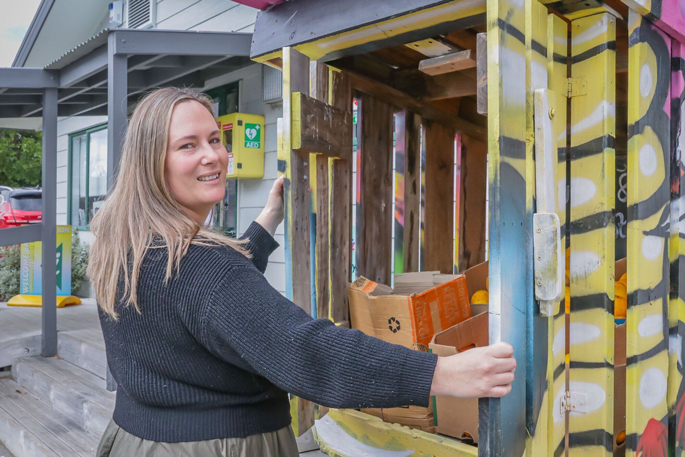
Wednesday is Welcome Bay Community Centre’s busiest day, with free clothing drawing in the community. Photo / Kelly O’Hara
The orange cupcakes and free coffee keep people flowing through too, because some just want a chat, she said. “This centre is here to combat isolation as well as help people.”
A free public advisory volunteer and Citizens Advice Bureau representatives also attend some Wednesdays.
Huria Trust hosts its Whānau Ora programme on Wednesdays, plus there is an Empower Her course to build resilience among girls aged 13-18 and youth boxing for those aged 8-14 after school, courtesy of Box n Booth.
On Thursdays, Ngāi Te Rangi run Poipoia Te Mokopuna, a free iwi-led playgroup for ages 0-6.
On Fridays, the centre is closed for walk-ins, but groups utilise the space, with a home birth group, an Honouring the Mother course, Becoming sessions for women aged 35-plus and The Welcome Bay Mahjong ladies among them.
Ruddell said with a cost-of-living crisis and people struggling to make ends meet, the centre was in high demand. “It’s all about helping the community – meeting them where they are at and trying to build them up by connecting them to the right services and support if we can’t help them.
“This is also a safe space – many people don’t want to go into clinical areas. It can be quite daunting for some. This is a space people know they are welcome.”
Another issue is public transport, Ruddell said. “We say Welcome Bay is like our own little island. It’s removed from the city centre and public transport and rising petrol costs make it hard to go into town all the time.”
Right now, the Welcome Bay community’s biggest needs were understanding, food support and socialisation.
“They just want somebody to listen to them,” Ruddell said. “The other thing is food. People come in daily needing kai, it’s huge for our community.” She wanted people to know they can gather produce from the community gardens above the centre at any time.
Loneliness was another issue, she said. “There’s not that village like there used to be, and I feel like this [the centre] a village for a lot of people.”
Ruddell, a fulltimer, runs the centre with three part-timers – but their volunteers truly make the wheels turn. “We have 15 core volunteers; others come and go. We wouldn’t be able to do any of this without them.”
She said it costs about $440,000 per year to run the centre, which included wages – except for a youth co-ordinator and youth worker, funded by a Tauranga City Council pilot programme.
Funding came from grants, with Merivale Community Centre manager Jen Murray helping file applications. “It is tough to fund this place,” Ruddell said. “Funding is becoming very dry ... the philanthropic trusts is quite an oversaturated market and not enough is coming in.”
Ruddell utilised gaming funders for wages but said her centre was up against many worthy non-profits. “It can be hard to fund wages, which is a big thing for us to be able to provide services.
“However, we do get donations. Real estate agent Nick Drysdale gives us $500 from every house he sells in Welcome Bay. That’s amazing – that really helps.”
Ruddell encouraged people to learn about the community centres’ September awareness campaign and donate if they can. Even $50 or $5 would be a huge help, she said, with $50 able to cover the centre’s baking ingredients for a few weeks, while even $5 “can go a long way. It means we can buy milk to offer people a cup of tea”.
To support the community centres’ campaign, visit www.bopcomcentres.nz.