A Tauranga-based, prominent Rongoā Māori practitioner has revised his book on traditional Māori medicine and released it – this time double its original size.
Rob “Pā” McGowan said it had been more than 15 years since he published Rongoā Māori: An introduction to Traditional Māori Medicine in 2010. It had sold more than 10,000 copies and shared the general principles surrounding traditional Māori medicine.
“Rongoā Māori is about keeping people healthy instead of waiting until they get very sick and then trying to find a cure for it,” said McGowan.
Now he has given the book a new lease of life, sharing deeper learnings of Rongoā Māori in his revised edition launched in Tauranga on September 1.
“The basis of Rongoā Māori isn’t rākau – isn’t plants, it’s actually wairua.”
The best way to describe wairua in English was spirituality, said McGowan.
“Traditional Māori medicine is not just about your sicknesses, your injuries, or diseases, but it’s about what you need so that you can be at peace within yourself, happy within yourself and well connected to the people and the things that actually really sustain you.
“Health is how we live really, and if we live in a healthy way we’re not going to have as nearly as much sickness, and sick people will recover better, so that really is the starting point.”
The ‘how’ of health
Understanding the natural world around us has always been a part of who McGowan is. “Ever since I was a little kid, I’ve always been fascinated in living things and growing things. It’s just been my whole life really.”
McGowan said he started learning specifically about Rongoa Māori 54 years ago on the Whanganui River, guided by Whanganui rangatira and senior chief Rangi Metekingi.
His first book was written quickly while he was completing a Rongoā Māori course. “[The first edition] summed up the main things that people need to know [about Rongoā Māori] and what resources were around at the time to help them with their learning.”
The revised edition would give readers more understanding of the “how” of traditional Māori medicine.
“People are expecting us to write a whole lot of recipes but it’s more about how you learn traditional medicine, because the actual medicinal properties of the same plant can change from place to place, and that depends on the climate and the soils,” McGowan said.
“What we’re talking about in the book is really – what’s the environment? Get to know the place where you live and then you’ll know when to harvest your medicine and how to make use of them.”
Tīwaiwaka
Now in his late seventies, McGowan said: “In the years since [the first edition], I’ve given lots of presentations and conferences, written lots and we’ve also developed Tīwaiwaka”.
The Tīwaiwaka 16% Collective is a group of leaders, practitioners and changemakers dedicated to placing Papatūānuku (the land) at the centre of decision-making in the Western Bay of Plenty.
“Basically, the foundation of Tīwaiwaka is ‘When the land is well, the people are well’,” McGowan said.
“Tīwaiwaka is really a pathway to actually make the land well again so that it will help our health, so I’ve incorporated that right through the book itself,” he said.
“Rongoa Māori is something that comes out of living with the land, so if we actually live here, it’s something that we actually need to have knowledge of – not so much to make medicine but to understand that way of connecting makes us who we are.”
Tapping into it
McGowan said his hope was that Aotearoa’s health system utilised Rongoa Māori more in future.
“I’ve been working with others to try and get the whole health sector to be much more open to traditional Māori medicine because we have got a health crisis in New Zealand. Lots of people can’t afford to get the medical help they need,” he said.
“The way I was taught is that you never charge for medicine. The old way was koha/donation.”
He advocates that incorporating Rongoa Māori in the health system would help alleviate health costs. “We keep saying to the people who control the health sector, ‘Open up your doors and welcome traditional Māori medicine because there is so much there to help a lot of people and it will help our health budget to save money’.

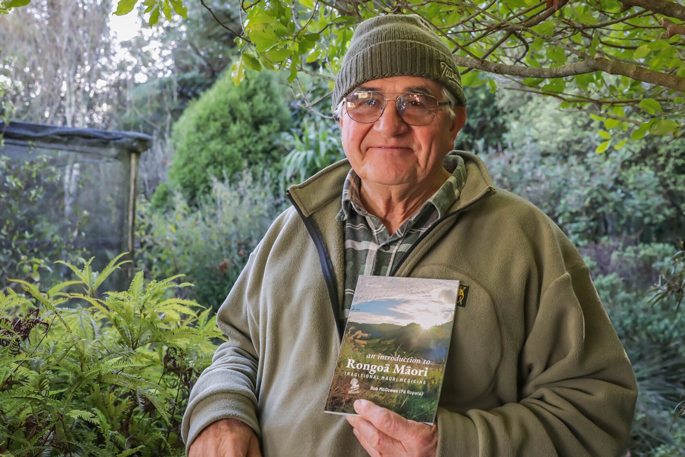
Rob McGowan wants readers to feel like they are walking through the bush when they open the revised edition of his Rongoā Māori book. Photo / Kelly O’Hara
“If we learn to live with what the world presents us to keep us well, we’re actually going to make for a much happier country because you don’t need lots of things to be happy. It’s about being able to find the balance in between all that,” McGowan said.
“I’m hoping that [Rongoa Māori] is going to become more and more a part of the New Zealand way of living.”
Thanks to McGowan’s generosity, The Weekend Sun has one copy of Revised: Rongoā Māori: An introduction to Traditional Māori Medicine to give away to a lucky reader who can tell us where McGowan started learning specifically about Rongoa Māori 54 years ago?
To enter, visit: www.sunlive.co.nz and click on the Competitions tab. Entries must be in by Tuesday, September 8.
The revised book can be purchased from The Tīwaiwaka 16% Collective website store at: https://tiwaiwaka.nz/store. RRP $40 but currently on sale for $30.