
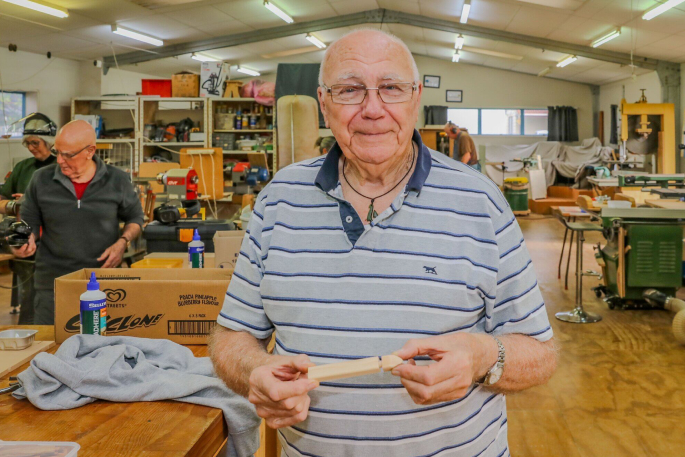
“It’s to make kids think,” Tauranga Woodcrafters Guild member Mike Buck, 87, said. “For a starter, they’re completely puzzled.”
That’s exactly the reaction House of Science hopes thousands of New Zealand children will have when they encounter one of 560 handcrafted wooden puzzles being made by the Tauranga Woodcrafters Guild.
The unique partnership between the two Tauranga charities will ensure the puzzles, known as Splinks, are included in House of Science’s What Do You Think? (He aha ō whakaaro?) science kits, encouraging children to observe carefully, ask questions and think critically like scientists.
The collaboration follows House of Science securing a $39.9 million, four-year Ministry of Education contract to supply hands-on science kits to every primary and intermediate school in New Zealand by mid-2027.

A completed Splink. Photo / Kelly O’Hara
House of Science production manager Anna Henson said the funding meant the charity had to swiftly increase production.
“We’ve had to upscale rapidly and increase the number of kits we have. The things we’ve made ourselves in the past now require some outside help,” she said.
“We are trying to find ways to keep things local and also maintain the quality and love that has always gone into our kits. The Tauranga Woodcrafters Guild seemed like like-minded people who are passionate about their craft, so we reached out to them.”
The partnership also had an unexpected connection, with one guild member having previously volunteered delivering House of Science kits.

Tauranga Woodcrafters Guild president Paul Glenton and member Gavin Bell. Photo / Kelly O’Hara
Buck has been instrumental in designing the specialised jigs that enable volunteers to produce the intricate wooden puzzles accurately and efficiently.
The retired woodworker said House of Science approached the guild after demand for the handcrafted puzzles outgrew previous production.
“They decided to give us a call and see whether we could handle it.”
He spent weeks developing custom jigs for every stage of the process, from cutting timber to identical lengths and routing precise points to drilling perfectly aligned holes.
“The most critical part is making sure every single point is exactly the same,” he said.
Early production wasn’t without challenges.
“We had a little bit of a problem with alignment on the drills. Initially we turned some out and they weren’t very good at all, so I reconfigured the jigs. Now we feel we’re on the right path.”

Tauranga Woodcrafters Guild members Mark Bennett and Mike Buck making Splinks. Photo / Kelly O’Hara
About six guild members can work simultaneously on different stages of production. During one five-hour session they completed about 170 Splinks, with the full order expected to take about five weeks working one day each week.
The deceptively simple-looking puzzle has a hidden lesson.
Children are shown how a pointed wooden piece appears to spring back into place after being pulled from the block. The apparent mystery encourages them to work out the real explanation - there is no spring or elastic band, only the demonstrator’s thumb and finger creating the illusion.
“It’s to make kids think,” Buck said. “They’re busy looking at you as you pull it out, not concentrating on the hand that’s actually making it work.”
Henson said the Splink was one of many activities designed to foster scientific thinking.
“It is designed to get students thinking like scientists to try and figure out how things work. There are many activities designed to get students observing, asking questions and thinking critically.”

House of Science production manager Anna Henson. Photo / Supplied
The 560 puzzles will be used in more than 2100 primary and intermediate schools across New Zealand as House of Science reaches full national coverage.
For Buck, the project continued a long tradition of supporting children’s learning.
Before Covid-19, the guild regularly hosted children who struggled in mainstream classrooms, pairing each child with a volunteer “woodwork granddad” for one-on-one mentoring while teaching practical woodworking skills.
“The results were just phenomenal,” Buck said. “The attitudes and everything started to change tremendously.”
While the guild is being paid for the House of Science work, Buck said the income would help sustain its community work.
“It helps us run our club. We teach woodworking to people who want to learn, including quite a lot of ladies, and it’s about us older generation trying to pass on the skills we’ve developed over the years.”
Henson said the collaboration reflected House of Science’s commitment to supporting local organisations while improving learning outcomes for children.
“We are a charity that was created to empower teachers and improve outcomes for children within our community. Where we can, we want to keep things local and, if there is an opportunity to create a partnership that mutually benefits another local charity that is also doing good within our community, that aligns perfectly with what we are all about.”
She said community support had been central to the organisation’s success.
“Making science accessible to every child in New Zealand is at the heart of what we do, and that becomes much more achievable when communities work together.”