
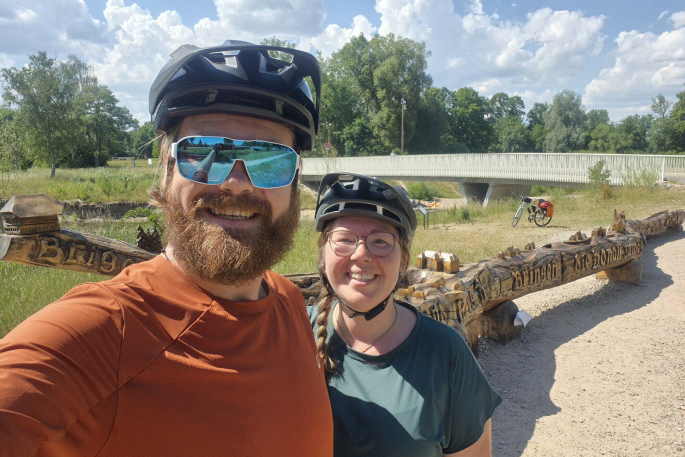
For most people, a cycling holiday might involve a few scenic trails, and a leisurely café stop. For Bay of Plenty conservationists Anna Wentsch and Callum Armstrong, it means pedalling nearly twice the length of New Zealand through some of Europe’s most diverse landscapes – all in pursuit of one goal: finding new ways to inspire people to care for nature.
The pair, founders of the Bay of Plenty-based Conservation Amplified Charitable Trust, set off on June 18 to cycle the full 2850-kilometre length of the Danube River, travelling from its source in Donaueschingen, Germany, to the Danube Delta on Romania’s Black Sea coast.
The 10-week journey is far more than an endurance challenge. Along the way they are documenting conservation projects, meeting scientists and local communities, and asking what New Zealand can learn from one of the world’s most international rivers.

The Danube Spring, regarded as the symbolic start of the Danube River. Photo / Conservation Amplified
For Wentsch, 32, the expedition is the fulfilment of a childhood dream.
“I grew up near the Danube and as a child we’d cycle parts of the river,” she said.
“I was always wondering what was beyond where we’d stopped. When the opportunity came up to do the whole journey we thought, ‘what better way to connect with the river than combining it with our passion for conservation?’”
Armstrong, 33, admits he enthusiastically agreed before realising quite what he’d signed up for.
“When Anna said she wanted to cycle the entire Danube, I said, ‘Absolutely – let’s do it’. Then I researched it and realised it’s about 2850km - almost twice the length of New Zealand.”

Callum Armstrong and Anna Wentsch on the first day of their Danube River cycle. Photo / Conservation Amplified.
The couple are travelling through up to 10 countries, averaging between 60km and 90km daily while coping with Europe’s summer heatwave.
“We’ve learned to get up before sunrise,” Wentsch said. “That gives us the cooler part of the day for riding.”
One early highlight was spotting a European beaver in Germany – a species once hunted to near extinction but now returning to parts of the river after decades of protection.
“It was really special,” Wentsch said. “Where we saw it is one of the areas they’ve naturally recolonised.”
The beavers’ comeback also illustrates one of the Danube’s biggest conservation challenges.
Much of the river has been modified with dams and channels for hydroelectric power and shipping, disrupting fish migration and floodplain ecosystems.

A great crested grebe seen in Germany. Photo / Conservation Amplified
One of the first experts they interviewed had spent two decades restoring fish passage around dams by creating bypass channels and reconnecting floodplains.
The experience had already given Armstrong a new perspective on NZ’s own environmental decisions.
“In Germany there are hydroelectric dams every 15km in some sections,” he said. “They’re now working with what they’ve already got and trying to recover what they’ve already lost.
“In New Zealand we’re looking at building more hydroelectric power stations. We need electricity - that’s a fact - but we also need to look overseas to understand the ecological consequences and learn from places that have already been through it.”
Armstrong said seeing Europe’s long history of development had highlighted the challenge of balancing conservation with industry, housing and economic growth.
“It’s opened my mind to the diplomacy involved when so many different interests are at play. Nature has to have a place alongside everything else.”

Callum Armstrong and Anna Wentsch’s bikes at the Passau Donau-Inn Confluence. Photo / Conservation Amplified
The expedition will eventually take the pair to the internationally significant Danube Delta, where they plan to document large-scale wetland restoration, the return of ecosystem-shaping herbivores and efforts to reconnect waterways for migrating fish.
If circumstances allow, they also hope to explore conservation work linked to neighbouring Ukraine.
“What really blows my mind is that despite everything happening because of the war, conservation efforts are continuing,” Armstrong said. “There’s an incredible story of resilience and hope there that we want to share.”
The entire expedition is being filmed as a three-part documentary series covering the Danube from source to sea, restoration of the delta, and conservation work continuing despite the challenges created by the war in Ukraine.
The couple launched Conservation Amplified in August 2024 after visiting New Zealand’s subantarctic islands through the True Young Explorer Scholarship programme.
“We realised there’s so much beauty on our doorstep, but most people aren’t aware of what’s happening or how they can help,” Armstrong said. “One of the biggest constraints to getting more action for nature is simply people knowing these projects exist.”

Storks in their nest in Germany. Photo / Conservation Amplified
The charity aims to reach new audiences through storytelling, podcasts, films and social media.
“We’re on a mission to make conservation mainstream,” Armstrong said. “Too often conservation talks to itself. We want to get people outside that bubble interested.”
Back home, they hope their journey encourages Bay of Plenty residents to discover local conservation groups restoring rivers, protecting wetlands or caring for native wildlife.
“I think we often frame conservation as ‘nature’s broken and we need to fix it’,” Armstrong said. “There’s truth in that, but it’s also about finding community. Helping nature gives people friendship, connection, exercise and purpose. It’s something everyone can be part of.”
As their wheels continue turning east towards the Black Sea, Wentsch said the biggest lessons are still to come. “We’re only at the beginning. There’s so much more to discover.”
Readers can follow the expedition through Conservation Amplified’s website, YouTube channel and social media, where the pair are sharing regular updates from the road.