
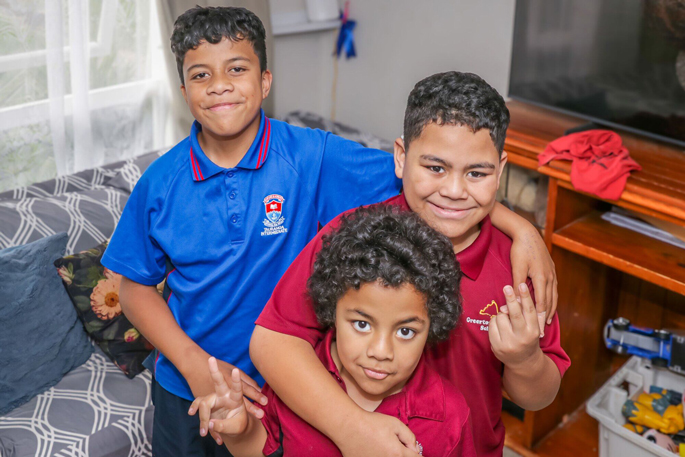
When Tauranga Intermediate Year 7 student Soni Moala suddenly began jumping in circles, shaking his arms and hands and loudly calling “Ha! Ha!” in front of an audience, he knew exactly what they might think. “What a weirdo. Is he alright? He’s crazy!”
He then asked the audience how they felt watching him. This was the opening of the 11-year-old’s speech that won first place in the Year 7 division of the Western Bay of Plenty Speech Competition.
His speech, ‘Life lessons from my brothers with autism’, was inspired by his two younger brothers, Moana, 10, and Ofa, five, who both have autism.
“But before you knew me you judged me,” Soni told the audience. “This is what my brothers have to go through for the rest of their lives being kids on the spectrum.”
For the Soni, the message was personal.
He shares a bedroom with his brothers and said growing up with them had taught him lessons about difference, communication, patience and kindness.
After struggling to settle on a topic, his mother, Aloi Koula, suggested he talk about his brothers.
“At the time they were playing around together, and I asked him how he would feel if he did a speech on them,” Aloi said.
Something he knows
Soni initially worried listeners would find the subject boring, but his mother told him to make it entertaining and relatable.
“He’s always with them. He’s their big brother,” she said. “[I thought] It would be easier for him to do a topic on something that he knows and he can educate others on.”
In his speech, Soni explained that autism was a different way of experiencing the world, comparing it to looking through someone else’s glasses: the world remains the same, but the way it is seen is different.
He described his brothers as being very different from each other, despite both being autistic.
“One won’t hurt a fly but will hold his nose if you talk too close to his face and the other one won’t hurt your feelings but will probably bite you,” he said.
“What we see as rude” behaviour, Soni said, may instead be part of how an autistic person experiences and communicates with the world.
“Behind every behaviour is a person trying to communicate. Be patient enough to listen.”
Soni also spoke candidly about his experience as an older brother, joking that he is “neither the referee nor protector” but “the instigator”.
‘Normal’
He talked about using his brothers as “tackle targets” and wrestling partners and teaching his youngest brother “puppy eyes” to use on their mother when they want McDonald’s.
He acknowledged that his family life was not always easy. Before embracing their differences, there were times when the family tried to teach the boys to be “normal”. “Normal is just a cage to put them in,” Soni said.

Moana Moala, 10 (left) with older brother Soni Moala, 11, and younger brother Ofa Moala, 5, holding Soni’s WBOP Speech Competition 2026 certificate and trophy. Photo / Supplied
Aloi said she and husband Mani helped Soni with some wording while he was developing the speech. At home, the multilingual family use English, Tongan and New Zealand Sign Language, supporting Moana, who is also hearing impaired.
“After he won, we went out to celebrate at Kwangchow,” Aloi said. “It was a happy moment for Soni, because it’s rare that we can go out and eat as a family as we have two boys who can be hectic around the buffet area, and picky with what they eat.”
Aloi said the public response to Soni’s speech had been overwhelming, particularly after Tauranga Intermediate shared a video of his winning performance on Facebook.
She said it was especially meaningful as part of the Tongan and Pasifika culture, where autism was not always openly discussed.
“There is support, but I don’t think there are people who are willing to come together and talk about their children,” she said.
Be kind
For Aloi, Soni’s speech is helping start that conversation. “We do it for our Pacific community as a whole. Not much is spoken about.”
Soni’s final lesson is one he hopes people will carry with them.
“In a world where you can be anything, be kind,” he said. “I want to protect my brothers that have autism. Let’s do our part to understand the behaviour and not misunderstand the person.”
For Soni, kindness is “like a superpower”. “It’s the strength to care when you could choose to judge.”