
Tauranga’s Turning Point Trust/Te Taiope Huringanui will celebrate three decades next week of helping people find connection, purpose and a pathway forward.
Based at the Historic Village, the trust was established in 1996 and has grown into a wide-ranging community-based service supporting people facing challenges from mental illness, addiction or disability.
The 30th anniversary would be marked with five days of activities shaped by the people who use the trust’s services, from August 31 to September 4.
Turning Point Trust general manager Tim Jackson said the organisation’s strength lay in its grassroots approach and its focus on what people wanted and needed. “We really aim to be a community.”
That community supports 300 to 400 people across the trust’s programmes, via about 30 staff.
Jackson said a main day programme offered a social and creative environment where people could participate in visual arts, mosaics, textiles, horticulture and kaupapa Māori programmes.

Jewellery maker Connie Lendrum and multi media artist Karen Calcott at Turning Point Trust’s shop Pōhewa – Imaginings. Photo / Kelly O’Hara
Vocational services helped people explore their next steps, whether employment, volunteering, study or simply developing skills and confidence.
“It’s not just trying to put people in jobs as the be-all and end-all,” Jackson said.
“For some, particularly if they are rebuilding after a downturn in their mental wellbeing or addiction issues, finding something that really has meaning and purpose for them might not be a job to start with.”
Other services included Te Whare Ti Rākau horticulture and Te Whare Pūeru clothing and textiles team, which upcycle discarded clothing and make it available to the community.
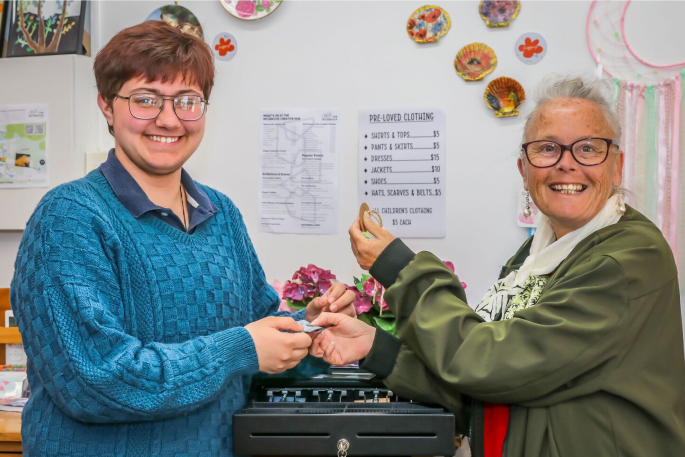
Arts and crafts made by members were sold via their village shop, Pōhewa-Imaginings, alongside local artists’ works.
The organisation had Junction, its community peer-support service, where staff draw on their lived experience of mental health, addiction or disability to support others.
Intake co-ordinator and Sage team lead Nicki Hockings said lived experience had become increasingly important to the way Turning Point worked. “It just enables them to support them more authentically.”

Turning Point Trust intake co-ordinator and Sage team lead Nicki Hockings. Photo / Kelly O’Hara
Jackson said the trust was firmly non-clinical and worked alongside clinical mental health, addiction and disability services.
Records dating back to 2015 show 912 people had used Turning Point’s services. The median time people spent with Turning Point was eight months, while the average was 17 months, reflecting the fact that some members remained part of the community for many years.
Jackson said the organisation’s flexibility was important. “Some people find their community here really different, and they just stay for years.
“Then they might go off and be doing other things, and then they might come and re-enrol. That’s the great thing – we can welcome people back.”
That flexibility meant the trust could respond to members’ ideas too. When members wanted to go on a camp, for example, staff worked to make it happen. “For people who don’t get to go on holiday, who don’t have the disposable income to go away anywhere, it felt really special,” Jackson said.
This philosophy has shaped the 30th celebrations. Members were surveyed about what they’d like to do, and the organising committee decided one event was not enough.

Turning Point Trust’s textiles and sustainability coordinator Rebecca Kit and sewing tutor Candice Whitmore. Photo / Kelly O’Hara
Celebrations begin with an opening ceremony on August 31, followed by morning tea.
Tuesday offers a community hāngi; Wednesday a Picnic in the Park; on Thursday, there’s a screening of Hunt for the Wilderpeople at Village Cinema. The week finishes with an anniversary disco Friday night.
On October 1, Turning Point will merge with Auckland-based Ember Korowai Takitini. Jackson said Turning Point would continue operating from Historic Village, under the same name and with the same people, while gaining the larger organisation’s financial backing and national reach.
For Jackson and Hockings, the organisation’s future was rooted in the principle that had guided it for 30 years: listening to the people who use its services and helping them find their own pathway.
“We’re so guided by them,” Hockings said. “We really aim to be a community, and we wouldn’t be able to do that without their genuine support.”