
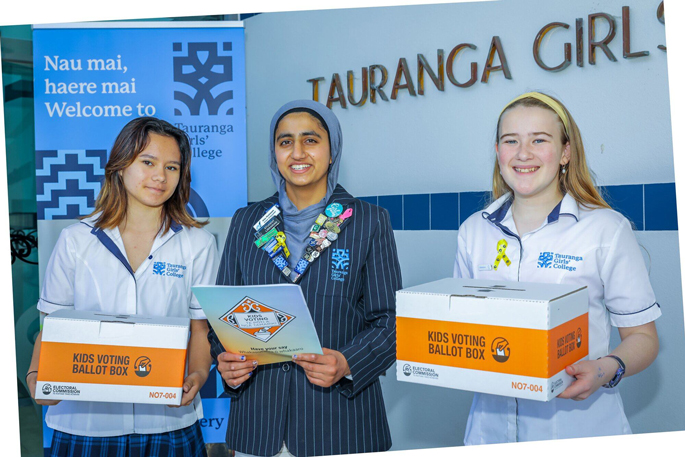
Tauranga Girls’ College students will get a taste of democracy next week, with a mock election aimed at helping the next generation of voters understand the power of their voice.
For Year 13 student and head prefect Aiza Mustasam, 17, the initiative is about more than learning how elections work – it’s about empowering young women to speak up.
“At Tauranga Girls’ College, we are very keen on ensuring that our young wāhine know that their voices matter and empowering those voices,” she said.
About 500 of the college’s Year 9-10 students have been learning about democracy, Parliament and the electoral system as part of Kids Voting – Te Pōti a Ngā Tamariki, a free Electoral Commission programme running in the lead-up to the 2026 general election.
The college’s mock election takes place on October 29, with three polling booths set up around the school during interval and lunchtime.
First-hand
Students will receive ballot papers and cast their votes for the same parties and candidates standing for Parliament, allowing the youth to experience the process first-hand.
Participation will be voluntary, reflecting the choice voters have in a real election.
Social Sciences leader of learning Nicky Hodson said the college signed up because of its belief that young people should understand how government works and their responsibilities as citizens, and because of the new curriculum.
“Even at their age they can still participate.”
About 22 Year 9-10 classes are studying civics this year, learning about the origins of democracy before moving on to Parliament, government and New Zealand’s electoral system, including the Mixed Member Proportional (MMP) system.
The college is also running one-off lessons to help senior students prepare for the upcoming election.
Hodson said students are interested in understanding how the system works, although some of the terminology and concepts are new to them.
Teachers are careful to remain politically impartial, encouraging students to form their own views.
“Our role is to educate them on how to think, not what to think,” Hodson said.
Students will be encouraged to research parties and candidates before casting their votes.
Hodson said the college ran a similar mock election at the previous general election.
Decisions affect futures
She hopes this year’s programme will help students recognise that political decisions affect their futures and that participating in elections is an important civic responsibility.
“The decisions made today are going to influence their future,” she said.
“We want them to be aware of the political climate so that when it is their turn, they make informed decisions.”
Mustasam said political discussions are already taking place among students.
“I’ve had so many interesting conversations around politics here, and it shows that students are highly engaged,” Mustasam said. “I think a lot of that also comes from us being influenced by parents talking about politics. These conversations are very encouraged at school as long as we’re being respectful of one another’s opinions and perspectives.”
However, she believes young people can feel disengaged when they think politicians are not listening to them or addressing issues that affect their futures.
A voice
Mustasam is concerned about the level of civics knowledge among young people across New Zealand, as well as the removal of fees-free tertiary education, saying such issues can leave young people questioning whether politicians care about their futures.
She wants young people to recognise that voting gives them an opportunity to influence decisions that will shape their lives.
“If I were to say one thing, it would definitely be to remind all the young people that we have a voice and that we should be using it in these upcoming elections, especially those who are aged 18 to 25,” she said.
“The more we continue to speak up, the better change there will be.”
Kids Voting – Te Pōti a Ngā Tamariki is a free Electoral Commission programme available to schools and kura from Years 0-13 during election years. Participating schools receive teaching resources and materials to run a mock election, allowing students to vote for the same parties and candidates standing for Parliament.