
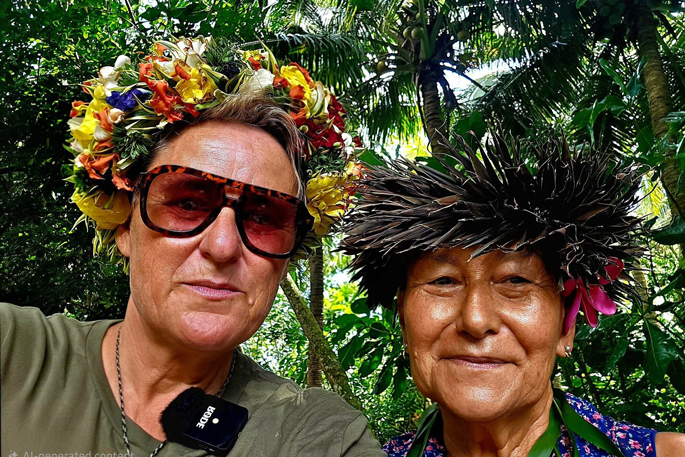
A chance conversation on holiday has led to a new conservation partnership between Waihī Beach and Rarotonga with automated rat traps now operating more than 400 metres above sea level in a remote cloud forest on the Cook Islands.
When Waihī Beach environmental coordinator Pippa ‘Pip’ Coombes visited Rarotonga last year, she was curious about the island’s conservation work.
She didn’t expect that conversation to eventually lead to volunteers hauling automated predator traps high into one of the island’s steepest and most inaccessible valleys.
Almost a year later, that is exactly what has happened.
Sustainable Waihī Beach, under the Live Well Waihī Beach umbrella, has partnered with Rarotonga’s Te Ipukarea Society (TIS) to introduce automated predator-control technology to the Takuvaine Valley cloud forest.
Ten AT220 and AT230 automated resetting traps have been installed more than 400 metres above sea level – the first traps of their kind to be used in the Cook Islands.
The high-altitude forest is an important refuge for native wildlife, including the Tahiti petrel, endemic skinks and native plants. Rats and feral cats pose a major threat, particularly to ground-nesting seabirds.
Steep, forested terrain
The challenge for conservation volunteers is getting to the traps.
Reaching the upper Takuvaine Valley means tackling steep, heavily forested terrain, making regular trap checks demanding and time-consuming.

Ian Karika, Raniera Ellison, Gemma Langley, TIS director Alanna Smith, Kas Silk, Gavin Steiner and Jacapo Dozzo. Photo / Supplied
Coombes said seeing the effort required to maintain predator control in such rugged country stayed with her after her first visit.
“These volunteers are doing incredible conservation mahi in extraordinarily difficult terrain,” she said. “It made me think about whether there was a way technology could help reduce some of the physical workload, particularly in those areas where every trip to check a trap takes so much time and energy.”
Unlike conventional single-set traps, the automated traps reset themselves after activation and can reset up to 100 times before needing servicing. They can remain in the field for up to six months.
For volunteers working in rugged mountain country, fewer trips into the forest could mean more time available for other conservation work.

Tukevaine Valley Cloud Forest. Photo / Supplied
Coombes first visited Te Ipukarea Society in 2025 after asking about conservation work on Rarotonga.
One of the island’s great conservation success stories is the recovery of the kakerori, or Rarotonga flycatcher. The endemic bird was reduced to 29 individuals in 1989 and was once considered one of the world’s rarest birds.
Decades of predator control and intensive conservation work had helped the population climb to more than 500.
Inspired
But Coombes also saw the enormous volunteer effort required to maintain predator control in Rarotonga’s rugged interior.
“I was really inspired by what the Rarotongan conservation community has achieved,” she said.
“The kakerori story shows what sustained, community-led conservation can accomplish, but it also highlighted just how much mahi goes into keeping predator control operating in such challenging terrain.”
That sparked an idea: could automated trapping technology developed and used in New Zealand reduce the physical workload for volunteers?

Gavin Steiner, Ian Karika, Kas Silk, Gemma Langley, Raniera Ellison, Jacapo Dozzo and Alanna Smith. Photo / Supplied
Coombes returned to Waihī Beach determined to find the funding to give the idea a try.
The result was $10,000 in funding and 10 automated traps, supplied with the help of NZ Auto Traps’ David Crimp, making their way from New Zealand to Rarotonga.
Coombes then returned to work alongside the TIS team and conservation volunteers during installation, sharing knowledge about trap placement, installation and maintenance while also learning from the Rarotongan conservation team.
Not one-way
For Coombes, that exchange is just as important as the technology.
“What I really love about this project is that it isn’t a one-way relationship,” she said.
“We have so much that we can learn from each other. Our Pacific communities share many of the same environmental challenges, and our taiao [environment] doesn’t recognise geographical boundaries.”
Getting the traps into place was a team effort. TIS volunteers Ian Karika, Raniera Ellison, Jacapo Dozzo, Gavin Steiner, Kas Silk and Gemma Langley, along with TIS director Alanna Smith, carried equipment into the steep Takuvaine Valley and helped establish the new traps.

Jacapo Dozzo and Alanna Smith with AT220. Photo / Supplied
The project was supported by the Takuvaine management kumiti, which is committed to biodiversity conservation in the valley.
Sustainable Waihī Beach hopes the relationship with Rarotonga will lead to further collaboration around conservation, sustainability, cultural exchange and environmental education, including opportunities for tamariki (children) from both communities to learn from one another.
Coombes said the partnership reflected the wider principles of kaitiakitanga.
“Kaitiakitanga is about relationships, responsibility and looking after what we have for the generations that follow us.”
More than traps
For Waihī Beach, the project is about more than 10 traps.
Coombes said that a trap funded from Waihī Beach can help protect a seabird in a Rarotongan cloud forest. Knowledge developed in one community can help another. And if technology can save volunteers a difficult climb up a mountain, those hours can instead be spent protecting more of the places and species that matter.
“This isn’t just about putting traps in a forest. It is about sharing knowledge, sharing practical solutions and building relationships between Pacific communities.”